 A Galileo Educational Network Site
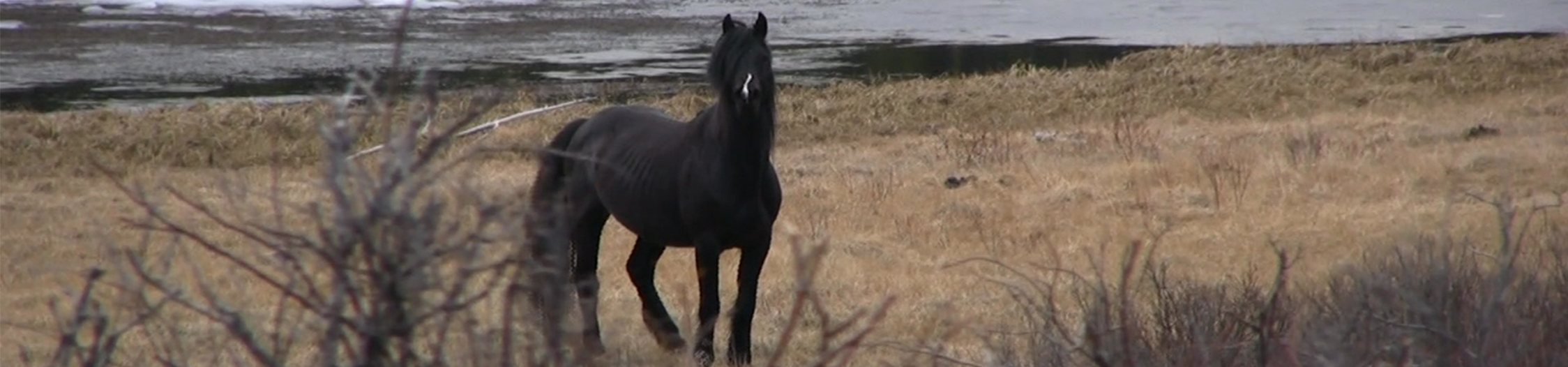
Any discussion of wild horses and their livelihood is tied to the land, and necessarily so.
Many factors are at play when looking at what contributes to biodiversity in any area, says Maureen Enns, a conservationist and artist studying wild horses in the Ghost Forest area.
“Biodiversity in my mind is when you have a piece of landscape that supports a variety of species of flora and fauna that can continue to thrive in each other’s company,” she says, noting wild horses play an important role in several areas:
Riparian Health
A healthy marshland is dependent on deep, strong roots. Wild horses fertilize marshland areas with their droppings, typically during the winter, when their hooves won’t get stuck and they become susceptible to predators, Enns says.
“We all know horse manure grows good gardens, so those roots go down deeper and deeper into the marsh. Wild horses are playing a big role in that, and therefore, in contributing to biodiversity in the area.”
Wild horses are often falsely accused of killing valuable flora, says Dr. Claudia Notzke, a geographer and university professor who has traveled the world studying wild horse populations.
“The horses nip off plants from the ground, they don’t rip them up by the roots, like cattle do,” she says.
Wild horses actually help other animals gain access to food during the winter, she adds, because they break crusted-over snow to get at the plants underneath during the winter, making it easier for other wildlife and cattle to do the same.
Relationship With Other Wildlife
Maureen Enns says wolves have killed many of the wild horses she’s studied over the years – and that’s not necessarily a bad thing.
“It keeps the numbers down on the range,” she says, explaining that in any animal population, if numbers are too great, overgrazing and overfeeding contribute to starvation, and therefore, a negative impact on the entire species.
When wolves feed on the horses, not only are they avoiding cattle in the process – which is good news for ranchers – they are contributing to a stronger group of wild horses, from a survival of the fittest perspective.
“There’s no room out there for weakness,” says Enns.
“And this is good, because only the really strong horses are coming forward and surviving to produce offspring. So genetically, we have some of the toughest horseflesh left in the world. Unfortunately, that has not been valued by the equine world – these horses have no predisposition to worms, they don’t need to be vaccinated, and if they’re weak, they die.”
The notion that wild horses compete with wildlife is completely false, Notzke says.
After a discussion with one scientist in particular, it reinforced her belief that many who hold this opinion haven’t observed wild horses in their environment.
“The scientist said the horses compete with moose, but they don’t eat the same thing. The scientist then said ‘well, there’s behavioural competition.’ I asked him what he had observed to prove that, and he said his proof was that he’d never seen them together, so therefore there must be behavioural competition. This is why it’s so important we establish more science on this.”
Relationship With Man
It would be nice to imagine any wild area untouched by humans – but that’s not realistic, or even possible today, says Enns.
Instead, we need to understand how to balance the desire of humans to enjoy these areas, with the very real need of protecting wild animals and their habitat.
“We’re only expanding in numbers, so how do we create a wild landscape and keep it for generations to come, where human activity, whether it be recreational or economic, can be part of the conservation of that wild landscape and contribute to its biodiversity?”
Ecosystem Engineers
Several years ago, Notzke studied an interesting experiment in Germany. The Hutewaldprojekt is led by university and government-based ecosystem managers, who reintroduced horses and other large grazers to a deciduous forest in an effort to increase biodiversity. It’s an effort that’s also been tried in Siberia, and has been met with some success. Those behind such projects acknowledge wild horses as a species belonging to that environment, even after a long absence. Notzke believes the same approach can be applied to wild horse populations in the Brittany Triangle in B.C.’s Okanagan, and in Saskatchewan’s Bronson Forest.
Travelling towards the Rocky Mountains west from Millarville Alberta you will see the foothills stretching to a ridge called Square Butte. This prominent ridge stretches from Banded Peak in the north to Allsmoke in the south with a panoramic view from the top of this ridge of the Rocky Mountains, endless wilderness, tree cover foothills and aspen forests of the valleys below.
The Stoney Indians traveled a treacherous wandering trail through this area during their annual spring migration from their home near the Bow River to their hunting grounds in the Sheep and Highwood River country and on further south. Following the ridges and across the valleys of the Square Butte, the Stoney were able to stay clear of the muskeg.
They set up their camps at the forks of the North Fork and Fisher Creek and set out to trade their goods and look for work. Often for payment of a horse, the Stoney would find work building fences for the ranchers of the Square Butte area.
In the quiet of a nonthreatening spring evening, at dusk from the west slope of Square Butte where the grass is green and lush, you will often see wolves, cougars, bears and wild horses eating, sleeping and moving about.
“To me these horses are wild,” remarks Donna Kendall whose family homsteaded in this area. They are herd animals very much like deer ears erect and searching always on the alert to protect the herd from eminent danger. There is no ownership of the land for these animals as they make decisions as a herd knowing and understanding of the risks of learning to cope with danger. They need space, trees and running water for survival.” Over the years Donna mentioned seeing horses with big feet for navigating the muskeg, untrimmed hooves, hairy legs and block shaped heads.
photo credits: Alicia Quist
Free roaming wild horses have been a part of the Okanagan for as long as people can recall. These horses are mostly found in the South Okanagan, near Oliver BC, Penticton, and Westbank (Westside Kelowna).
In British Columbia, the Chilcotin holds the last major numbers of wild horses. Reports from the Ministry of Forests in Alexis Creek, indicates that there are about 400, including 75 in the Brittany Triangle. The Brittany Triangle is bounded on the west by the Chilko River, on the East by the Taseko, and to the south by Nemaiah Valley and the South Chilcotin Mountains.
Until recently this area has been protected by its isolation, an isolation which has allowed the 380 strong Xeni Gwet’in First Nation to retain its way of life and its culture. Many of the elders still speak only their own Chilcotin language, and it is taught by immersion in the local school. The Xeni Gwet’in still practice a horse culture and closely identify themselves with their horses.
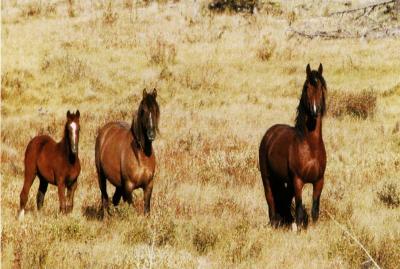
The Ghost Forest and Central Foothills, located west of the towns of Cochrane and Sundre, Alberta, and east of the Rocky Mountains, is home to a several industrial and recreational interests, in addition to being home to a variety of wildlife, including the wild horse.
It’s estimated the Ghost Forest area, which is further south and is located near the Stoney Nation, is home to about 50 wild horses. The Central Foothills, on the other hand, has a larger wild horse population of about 250. Unfortunately, this population has been targeted by poachers in recent years. It’s been said in order for a group of wild horses to maintain genetic diversity, a minimum breeding population of 150 is required. This is why several groups and individuals are banding together to save not only the wild horse, but their habitat as well – a challenge, given the variety of interests in these areas.